Mike Heck
Choice of equipment Rods, reels, fly lines, fly floatants, clothes, glasses, and other useful items.
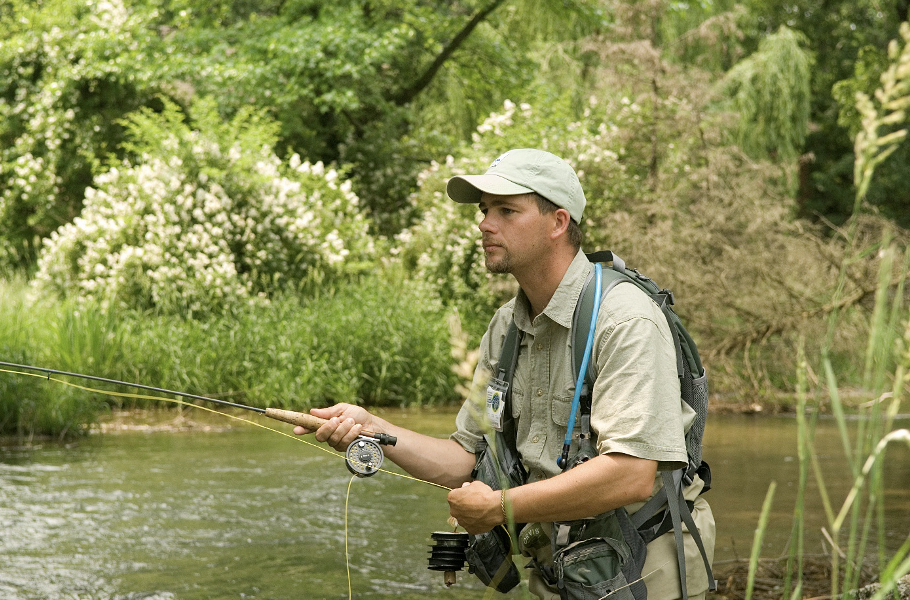
My preparation and approach to fishing starts off with proper clothing. I want clothing which blends into the environment. I prefer to wear Skwala clothing and waders. They’ve designed their clothing in dull colors only. They make a variety suited for the extreme cold all the way to hot summer days. Their waders will outlast any other wader out there.
Next is my rod choice. I have what I call my, “All-a-round” rod. I go with my Thomas & Thomas Avantt II matched with Scientific Anglers Amplitude Smooth fly line. The combo works for any stream condition all the way to low and clear water. It will shoot line during breezy conditions and gives me the option to cast a double fly set-up like dry/droppers of two dry flies.
Now, as summer really sets in water conditions can become very low and clear. Plus, I’m dealing with a high sun angle. For dry fly fishing, I switch to my Thomas & Thomas Lotic fiberglass rod accompanied with a Scientific Anglers Textured Fly line. It is a much slower rod, and with my casting style I’m able to get a much softer, delicate fly presentation.
I used to never were sunglasses, but times have changed. Lately, I have had way too many flies pass to close to my liking while guiding. Now, I use Suncloud sunglasses. I like the amber colored optics because they work well under all lighting conditions.
Now for all the gadgets that we have to carry such as forceps, nippers, etc. They are stowed away in my chest pack if they are shiny. I’m a believer that sun can reflect off any essential tool and can spook trout.
Lastly, the one thing that I always am sure to have plenty of is dry fly floatant. I tie a lot of my dry flies with CDC and Snowshoe rabbit. Any powder floatant is safe on these materials and I have seen very good results with High & Dry.

Leader material, build-up, length and knots.
I believe in, “If it is not broken; do not try to fix it”. I use the George Harvey leader for everything, especially when it comes to dry fly fishing. The formula is designed to roll over in the air and as it settles to the water the lower sections collapse. This creates “S curves” aiding in a drag free drift.
It is very simple to achieve this with the traditional over-head cast. At the end of the forward cast the rod tip is stopped high and then slowly deelevated to parallel. This is known as the “check”. The quicker the delevation of the rod, the more the leader will ball up. Now as the dry fly drifts, the “S” curves begin to straighten out. This allows the dry fly to dead drift as you keep a tight line into the upper butt section of the leader.
I use Maxima Ultragreen for the first four sections. 2X is the hinge point and from 2X all the way to the tippet I use Scientific Angers Absolute Trout monofilament.
If using a loop to loop connection a perfection know is used for line to leader attachment. A nail knot can be used if you’re not a fan of the loop to loop.
To build the leader, I like a nail knot. It provides a much straighter knot than a surgeons knot. And last, I just use a clinch knot to tie the dry fly to the tippet.
Leader Formula:
.017 – 10 to 12 inches
.015 – 12 to 15 inches
.013 – 12 to 15 inches
.011 – 12 to 15 inches
2X – 12 inches
3X – 13 inches
4X – 13 inches
5X – 15 inches
6X – 25 to 30 inches

Approach and stealth.
My on-stream observations dictate the approach I will be attempting. Read the water conditions first. Is the water a glassy flat or riffles and is the stream flowing clear or stained.
If the stream is clear, I almost always am fishing upstream. This keeps me all but completely hidden for the trout. If circumstances force me to approach from the side, I stay as low as I can and move very slowly.
Stained water is a huge benefit for the angler. Trout may not be as skittish under these conditions. I will now approach from the side more. The big benefit is that I can sneak in much closer.
I try not to fish downstream that much because this puts me in direct sight. However, it may be necessary. Bridges, brush, or trees may just hover over the water making a cast impossible. A downstream drift is now needed. The biggest pointer I can put out there is retrieve the dry fly back slowly. First, it is less likely to spook the trout and I have actually had takes as retrieving the fly back to me.
Upstream or downstream?
I try not to fish downstream that much because this puts me in direct sight. However, it may be necessary. Bridges, brush, or trees may just hover over the water making a cast impossible. A downstream drift is now needed. The biggest pointer I can put out there is retrieve the dry fly back slowly. First, it is less likely to spook the trout and I have actually had takes as retrieving the fly back to me.
Rise forms Can they tell us something?
So, the trout are on the rise. Take a few minutes to see what is hatching while studying the riseform. Several different insects may be on the surface at the same time and now the riseform can be the indicator of what a trout is keying on.
Midges- The two riseforms commonly seen with midge sipping trout are “Dimples” and just a subtle push of the water’s surface. Dimples usually mean a trout is keying on the tiny adult midge. I want a midge that floats well. I like parachutes, CDC winged patterns and simple hackle patterns with different colored dubbed bodies.
The subtle push of the water is unseen by most anglers. In these instances a trout is feeding on emerging midge pupas. Now I want a pattern that rides low in the film. I like my Mike’s Midge Pupa which I designed that the CDC rides just in the film and the other ¾ of the hook hangs below the film.
Mayflies- Unfortunately mayflies can also be inhaled with the same midge riseform. This is common when the mayflies are very tiny. However, mayflies will provide the classic, “Head to Tail” rise. I stick with the same execution. If just a water push, I go with CDC and Snowshoe emergers and “dimples” I try compara-duns and parachutes. High floating hackled dries are fished for “Head to Tail” rising trout.
Caddis- Most often trout rising to caddis is a very easy rise to figure out. Hatching caddis do not float on the surface. As they emerge, the pupa fills with air. When it reaches the surface, it immediately sets into the air. So caddis riseforms are usually explosive often observing trout lead from the water chasing their diner.
Fly selection, Size, shape, materials, which flies are essential.
Elk and deer hair caddis are my choice flies. They float very high. If I’m observing a trout constantly chasing caddis movement my be needed. Here I will present my dry fly as normal, but retrieve all the slack so I can give my caddis pattern a gentle twitch. A heavily tied CDC caddis can add movement wile drifting drag-free.
Stoneflies- Now at last, I do not have to worry about any rising trout to the stonefly hatch. Stoneflies crawl out to the water to emerge. But, in just a very few cases trout may feed on them if there is a heavy fall of egg-laying stoneflies. The rise is a very splashy rise. This is more common on the United Stated western streams. One of the most famous is the Salomon fly hatch. In this rare Eastern United States event a simple Stimulator usually does the trick.
Lastly and very important to remember in insect and rising trout. Light conditions is a big factor in just how particular a dry fly must be. A trout’s eyes continue to refocus under light conditions. If it is daytime and bright out, trout really key on fly size and color. A low light day, dusk into nighttime fly fishing a trout will key more on the silhouette of the pattern rather than color.
Everything has came together and now a trout has inhaled the dry fly it was offered. I tip set. I like to set with the rod tip. I set just hard enough to imbed the hook. I tell beginners, “pretend you are making a medium-soft back cast”. Dry fly tippets are light and many set too hard and break the fly off immediately. Plus, it gets my rod up to the fighting angle right away because this trout is not happy and will begin to fight back.
Fighting fish
Now how I fight a trout is entirely up to the trout. No matter what, keep the fly rod pointing at the sky. If it decides to run, let it while keeping light pressure until the run is over. Also move the rod tip left or right. This is referred to as “side-pressure”. It will tire the trout out much quicker. If a trout decides to say “HI” and go airborne remember this, “Bow to the king”. While the trout in the air lighten up all but completely on the pressure. Once it is back in the water, apply the pressure back.